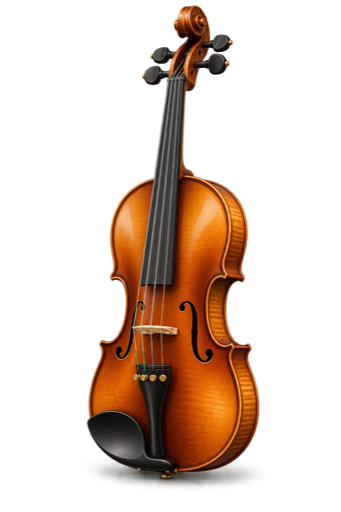
How to tune a viola
The strings run C3, G3, D4, A4 from low to high — a fifth below the violin on every string, with a larger body and heavier strings. Start on the 4th string (C) and work up. The C string is thick and slow to answer, so give it a second or two before you trust the reading. Use the fine tuners for small corrections and the pegs only when the pitch is far off, turning slowly while pushing gently toward the scroll. Recheck the previous string after each one, because all four share the tension across the bridge.
Viola tuning tips
The viola C string is around 130.8 Hz — lower and darker than anything on a violin, with fewer overtones, so it needs a longer sustained note before the reading settles. A long bowed open string is steadier than pizzicato: even bow speed, close to the bridge but never pressing. Viola pegs slip easily; seat the peg with a gentle inward push as you turn, and if it still lets go immediately, use peg compound or have a luthier refit it.
Is microphone audio uploaded?
No. Web Audio analyzes sound in real time on your device. This page does not record, upload or store microphone audio.
Frequently asked questions
How does viola tuning relate to violin tuning?
The viola strings C-G-D-A sit exactly a fifth below the violin G-D-A-E, so left-hand fingering and positions transfer directly — but viola music is written in alto clef.
Why does the C string drop again right after tuning?
It is the thickest string under the most tension, so a new string or a slipping peg will pull it back down. Push the peg gently into its hole as you turn; if it still slips at once, use peg compound or have the peg refitted.
Does a viola also use A4 = 440 Hz?
Yes by default. When playing with a fixed-pitch instrument or an orchestra that asks for another pitch, open Advanced settings and set A4 anywhere from 415 to 466 Hz.
Is a viola harder to tune than a violin?
A little. The larger body and heavier strings change pitch more slowly, so wait longer for a stable reading before you judge.
